
The Bees return from the international break for their first Monday-night fixture of the season.
Recent history
Brentford were unbeaten against Everton last season, winning 4-2 away and drawing 2-2 at home. Igor Thiago scored five goals across the two matches.
Opta Power Ranking
As of 17th November, Opta ranked Everton a few places above Brentford in its global rankings.
| Team | Global rank | Rating |
|---|---|---|
| Brentford | #21 | 92.1 |
| Everton | #16 | 92.4 |
Familiar face
Former Bees captain Christian Norgaard will make his second visit to the Gtech as an opponent. He was an unused substitute for Arsenal when they visited in February 2026. Unfortunately for Norgaard, that has become an unwelcome trend: it happened 28 times in the league with Arsenal last season and has already happened four more times with Everton this season.
Red-card blues
The Bees will be without Thiago for the next three games following his red card against Brighton. He'll be missed, but his absence will give others an opportunity.
Wilson in the wings
Callum Wilson is a likely beneficiary. He scored against Everton last season and also netted twice in three separate matches against them while at Newcastle. It's been a year since he last started three games in a row. In November and December 2025, he scored three goals across five consecutive starts.
Data stories
The impact of red cards
The two red cards the Bees have received this season have clearly affected their games: their only defeats have come in those matches.
Both red cards came in the first half, so the Bees have spent a lot of time playing with ten men. In fact, they have spent the second-most time short-handed in the league, behind only Crystal Palace.
Here, we look at how much time each team has spent with ten men this season after a player was sent off.
2026-27 Premier League minutes short-handed (source: Correlation FC)
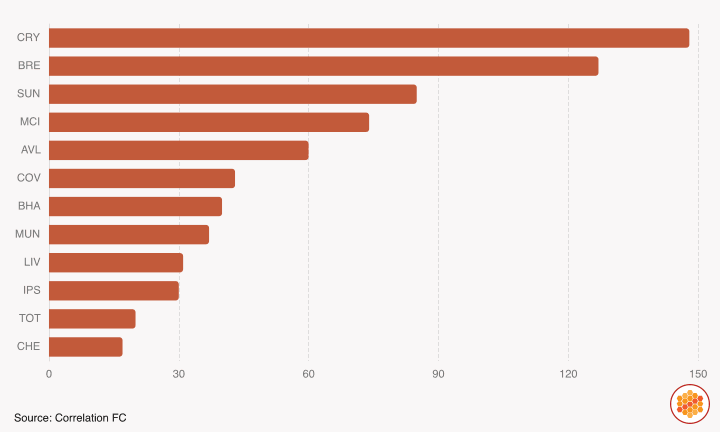
The Bees have already spent the equivalent of nearly a game and a half with ten men. This isn't an entirely new trend: across their time in the Premier League, they have cumulatively spent more than five and a half games short-handed.
Premier League leaders in time spent short-handed since 2021-22 (Source: Correlation FC)
| Team | Minutes Shorthanded | Goals For Shorthanded | Goals Against Shorthanded | Goal Diff Shorthanded |
|---|---|---|---|---|
| Chelsea | 712 | 5 | 18 | -13 |
| Wolves | 592 | 3 | 13 | -10 |
| Brentford | 504 | 2 | 10 | -8 |
| Crystal Palace | 501 | 2 | 12 | -10 |
| Arsenal | 471 | 0 | 10 | -10 |
| Spurs | 447 | 3 | 15 | -12 |
Not all red cards are the same. One difference is the timing: a team whose player is sent off early in the first half may have to play with ten men for an hour or more, while a player sent off in the 89th minute may leave their team short-handed for only a few minutes.
So what does the data tell us? Are early red cards more damaging, or can teams that have to change their tactics late in a match suffer more than those with time to adapt?
Sending off timing and goal difference (source: Correlation FC)
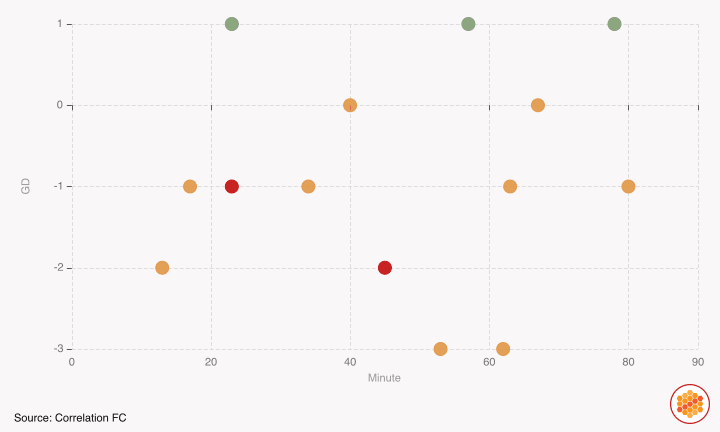
As the chart shows, three teams have recorded a positive goal difference after having a player sent off. The red cards came at very different points in the match: the 23rd, 58th and 78th minutes. Aston Villa, meanwhile, did not concede after receiving a 40th-minute red card against Brighton—a remarkable outcome, given they had already conceded four goals.
The Bees' own performances suggest that the timing of a red card does not, by itself, determine the goal difference for the rest of the match. Against Liverpool, the red card came at the end of first-half stoppage time, and the Bees' goal difference in the second half was -2. Against Brighton, the sending-off came much earlier, but their goal difference after it was only -1. The picture is a little more complicated than timing alone.
2026-27 Premier League goal differences while a man down (source: Correlation FC)

In matches without a red card, the Bees have averaged a positive goal difference of +0.92 per 90 minutes. In matches in which they received a red card, their goal difference before the sending-off was zero; after going down to ten men, it fell to -2.06 per 90 minutes.
Goal difference per 90 minutes before/after red cards (source: Correlation FC)
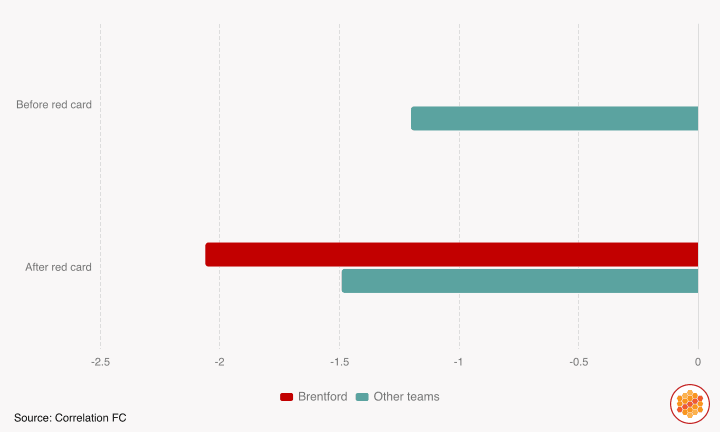
Their zero goal difference before a red card does not show up on the chart, but it is much better than the average for teams that received a red card, whose goal difference was about -1.2 per 90 minutes. On average, teams had a worse goal difference per 90 minutes after a red card. The Bees performed better than that average—but it's not a trend they'll want to continue.
Impact on game state
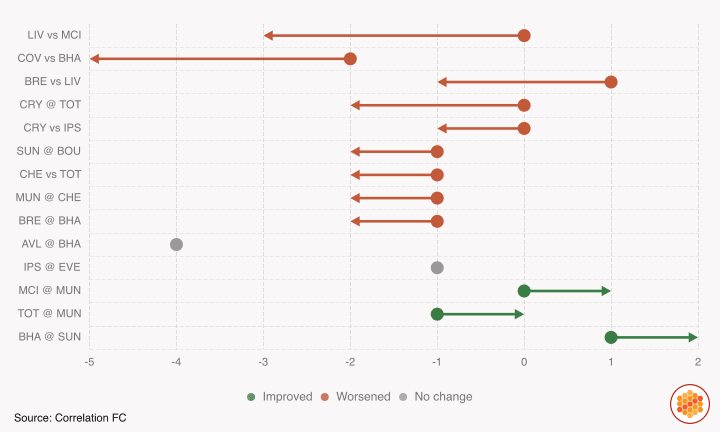
We'll take one final look at red cards in the 2026-27 Premier League season thus far. Here we can see the change in goal difference from before and after the sending off. In five cases, teams that were already losing, went on to lose by an even bigger margin. A further three that were even went on to lose. Brentford against Liverpool is the only time this season where a team went from winning to losing after receiving a sending off. Two matches show no change in goal difference and three show an improved situation for the short-handed teams.
Goal difference change after sending off (source: Correlation FC)
Let's hope that this is the final time we need to speak about red cards this season.
This story was published on 19 November 2026. This story and the image at the top of the article were both created with care, by humans, not AI.


